01 / Software description
An end-to-end uncertainty quantification workflow
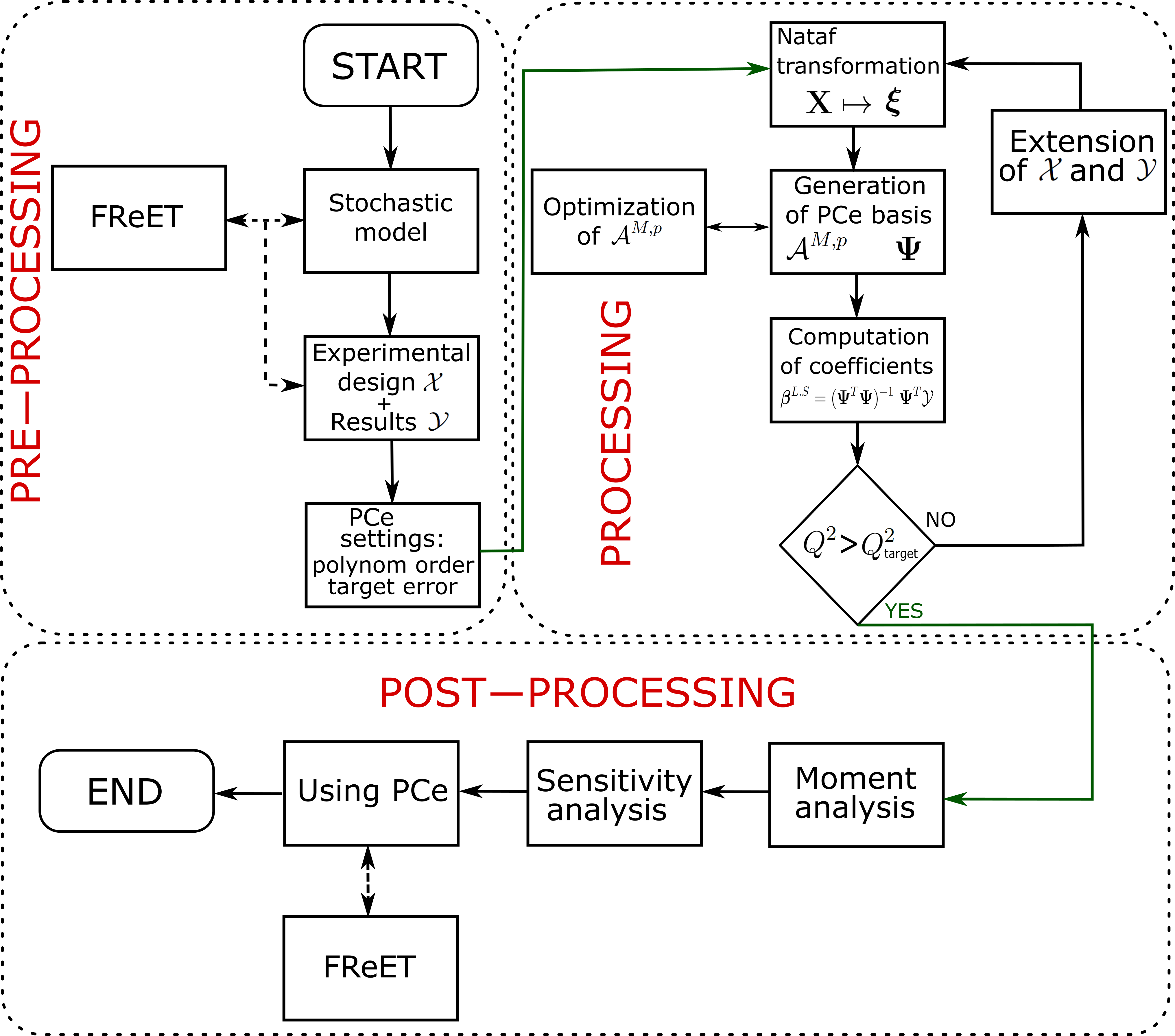
The software is divided into three parts: pre-processing, processing, and post-processing.
Pre-processing
Users define the stochastic model of the problem, including marginal distributions and the correlation matrix, then create an experimental design with the corresponding results from the mathematical model. This can be done in cooperation with third-party software such as FReET. The final pre-processing step sets the target accuracy of the approximation or the maximum polynomial order.
Processing
Processing is fully automatic. Its core is an iterative best-model selection algorithm together with adaptive sampling techniques.
Post-processing
Post-processing provides sensitivity analysis of input random variables using Sobol indices and statistical analysis of the quantity of interest through its first four moments. The PCE can also be used as a computationally inexpensive approximation of the original model for time-consuming analyses, such as Monte Carlo estimation of low failure probabilities in physical systems.
Project acknowledgment. The original SEMIP page states that PCE-UQ was developed with financial support from the Technology Agency of the Czech Republic (TAČR), project TH04010138.
02 / Theory
Theoretical background
The theory of PCE-UQ was described in the following scientific journal paper:
- L. Novák and D. Novák, “Polynomial chaos expansion for surrogate modelling: Theory and software,” Beton- und Stahlbetonbau, volume 113, 2018. ISSN: 1437-1006.
03 / Selected work
Further developments & applications
Additional details of PCE-UQ, theoretical innovations and applications are described in these selected papers:
- L. Novák and D. Novák, “Surrogate modelling in the stochastic analysis of concrete girders failing in shear,” in Proceedings of the fib Symposium 2019: Concrete – Innovations in Materials, Design and Structures. International Federation for Structural Concrete, 2019, pp. 1741–1747. ISBN: 9782940643004.
- L. Novák, D. Novák and R. Pukl, “Probabilistic and semi-probabilistic design of large concrete beams failing in shear,” in Advances in Engineering Materials, Structures and Systems: Innovations, Mechanics and Applications. London: Taylor & Francis Group, CRC Press, 2019. ISBN: 9781138386969.
- L. Novák, L. Pan, O. Slowik and D. Novák, “Advanced reliability and sensitivity analysis of prestressed concrete girders failing in shear,” in Proceedings of the fib Ph.D. Symposium, Prague, Czech Republic, 2018.