Prepare data
Define the first four central statistical moments manually or load measurements from a CSV file. Configure numerical algorithms for Bayesian updating and statistical testing using the Kolmogorov–Smirnov test.
Software · Bayesian uncertainty quantification
A standalone tool for uncertainty quantification and damage identification in existing structures using measured data.
Original BayesianUQ page at BUT ↗01 / Overview
BayesianUQ is a standalone software tool for uncertainty quantification and damage identification in existing structures. It performs Bayesian parameter updating of a Gram–Charlier expansion based on real-life structural measurements.
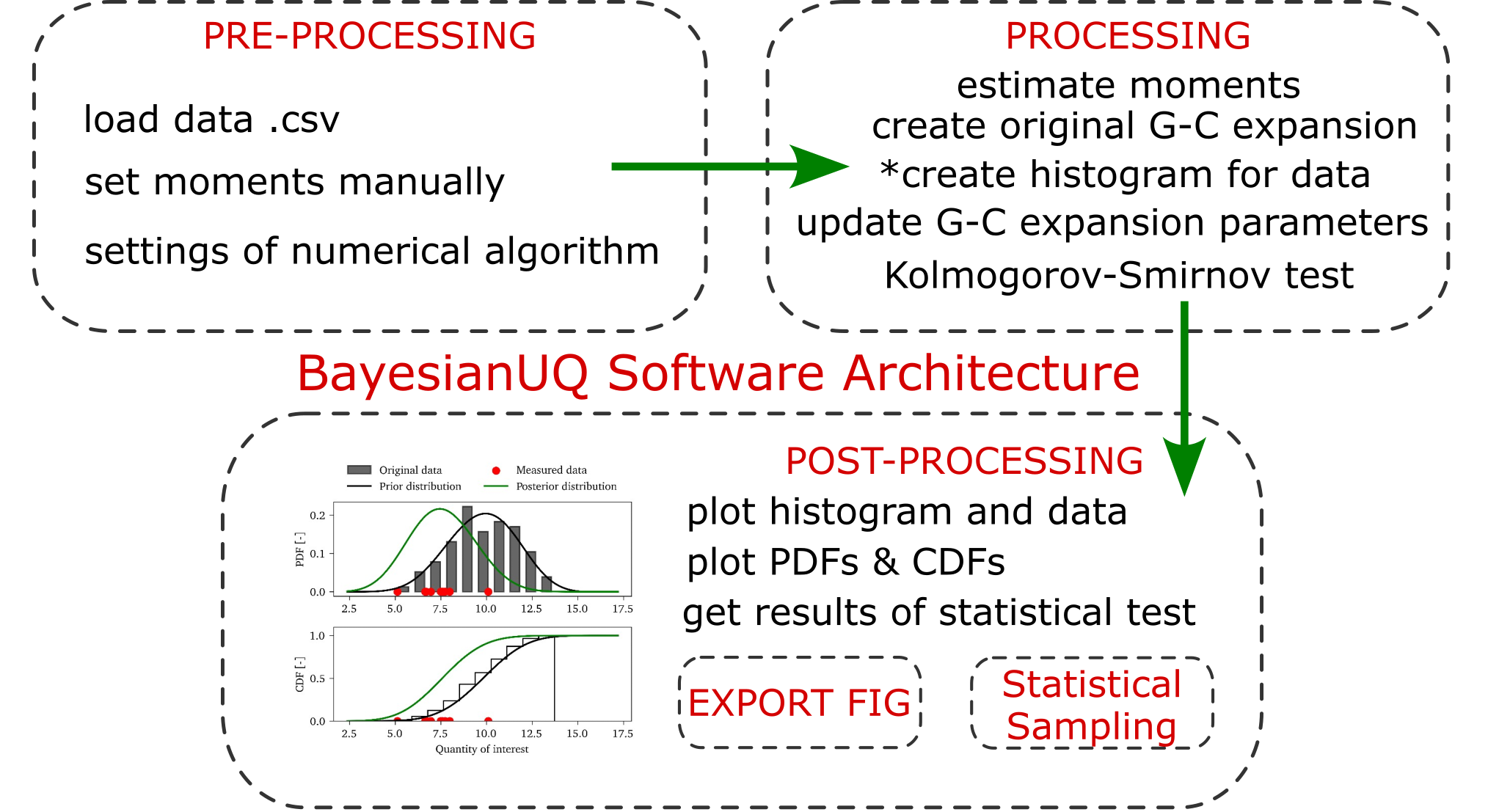
The software has three stages: pre-processing, processing and post-processing. In pre-processing, users define the first four central statistical moments manually or load measurements from a CSV file, then set the numerical algorithms for Bayesian updating and Kolmogorov–Smirnov statistical testing. Processing is fully automatic: it updates the Gram–Charlier probabilistic model using the measurements and performs statistical testing for damage identification. In post-processing, users can plot results and use the expansion for statistical sampling.
Project acknowledgment. The original page acknowledges financial support from the Technology Agency of the Czech Republic (TAČR), project TM04000012.
02 / Workflow
Define the first four central statistical moments manually or load measurements from a CSV file. Configure numerical algorithms for Bayesian updating and statistical testing using the Kolmogorov–Smirnov test.
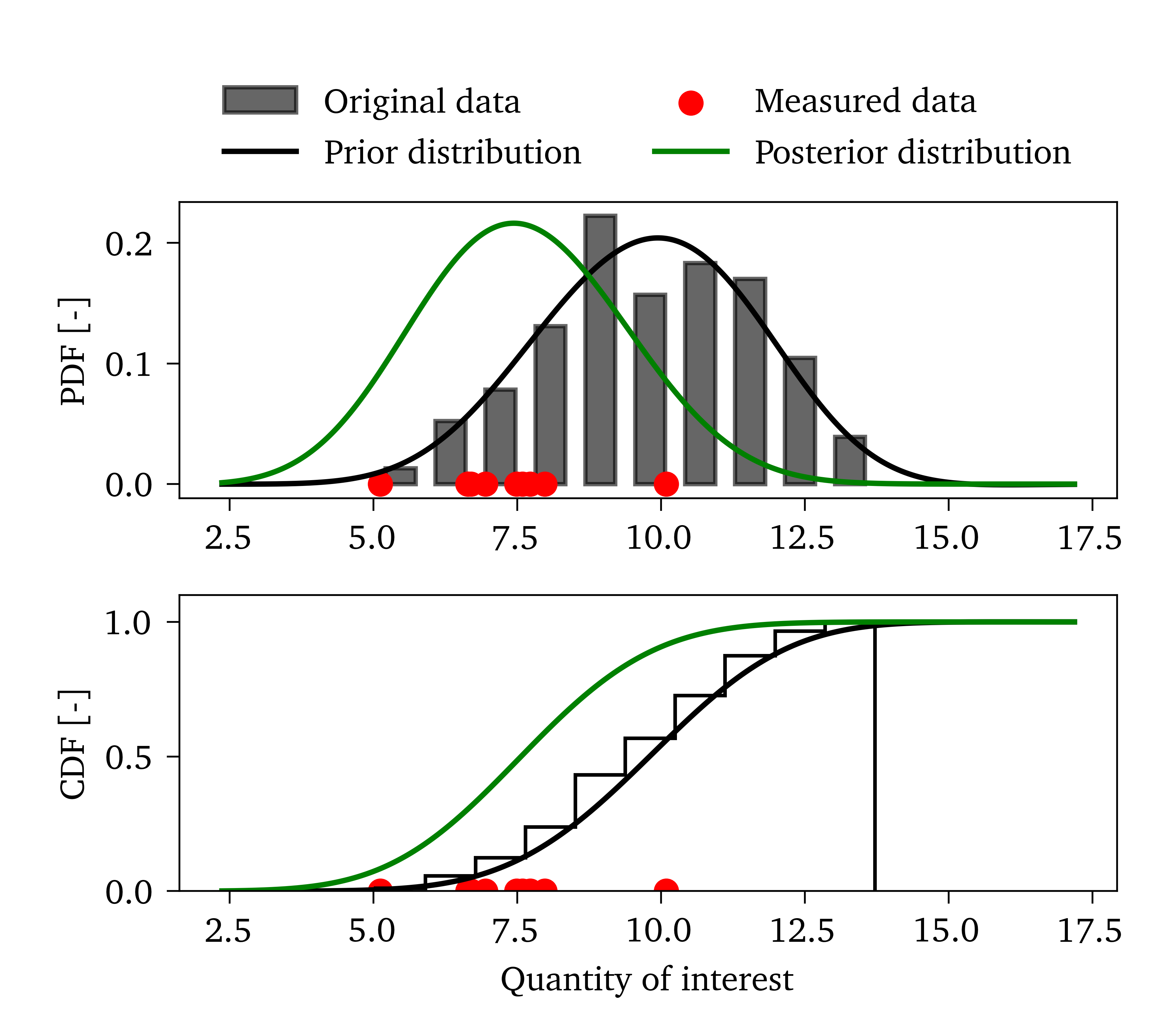
Processing runs automatically. Its main task is to update the probabilistic model, represented by a Gram–Charlier expansion, on the basis of measurements and to conduct statistical testing for damage identification.
Plot results manually and use the Gram–Charlier expansion for statistical sampling.
03 / Theory
The theoretical methods implemented in BayesianUQ are described in:
04 / Applications
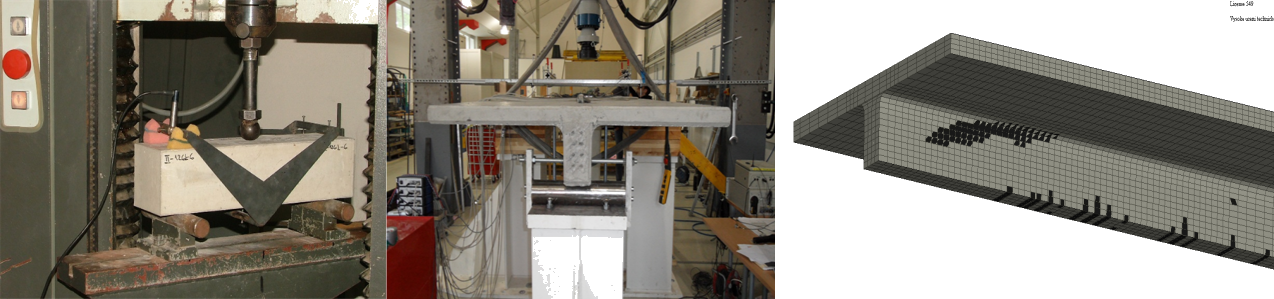
The software was developed in collaboration with industrial partners within TAČR project TM04000012. The original page describes validation and applications to be completed in 2025.
05 / Contact
For information about BayesianUQ and its potential applications in research or practice, contact the main developer:
Lukas Novak
novak.l@fce.vutbr.cz
Institute of Structural Mechanics
Faculty of Civil Engineering
Brno University of Technology, Czech Republic